The distance between a certificate and a career is usually one relationship
The word that started to bother me, about twenty minutes into the panel, was skills.
Five of us, one each from Kenya, Zimbabwe, Nigeria, Uganda and Ghana, for an hour on the Mastercard Foundation's Young Africa Connects, and we were being careful with each other in the way panelists are. Priscilla talked about TVET systems built for an industrial economy. Lindisi talked about what has to shift in someone's head before any AI training can begin. Aisha had built an AI livestock marketplace with a chemical engineering degree. Yoal was describing young people in Kiryandongo who may not have reliable electricity, let alone a laptop. All of it was true. And I caught myself nodding along to a framing I do not actually accept.
Because the numbers we kept circling do not describe a skills problem. Ten million young people enter the African labour market every year and roughly three million formal jobs are created to meet them. In Ghana, youth unemployment sits near 32.5%, and about 1.3 million young Ghanaians are not in employment, education or training, three-fifths of them women. You cannot train your way out of a seven-million-job arithmetic gap. Something else is happening.
I hire. That is the vantage point I brought, and it is a narrow one, but it is specific. CVs arrive at Faciotech from young developers who have done exactly what they were told would make them employable. They have the certificate. They know the framework. They can reproduce the tutorial project faithfully. This is the most credentialled generation in Ghanaian history and they are not bluffing. The work behind those certificates is real.
Then we hand them a problem whose edges have not been drawn yet, and a good number of them stop. Not from incapacity. They are waiting for a brief, and the brief is the thing that does not exist. They can execute one beautifully. Almost none of them have been asked to write one.
I used to describe that as a training failure, and I was comfortable describing it that way for longer than I should have been. It costs us something like three months per hire to close, which is how a small company quietly becomes an unpaid academy, and I have complained about that cost in rooms full of people who agreed with me.
The complaint is not honest, though, or not entirely. We demand experience while rationing the places where experience can be got. Then we read the resulting hesitation as a defect in the applicant rather than as the predictable output of a system we help run. I have turned down people who would have been good with three weeks of decent supervision, because three weeks of decent supervision was not something I had costed into the project. That is not the university's failure. That is mine.
So the gap I actually see is not between what young people know and what employers need. It is between knowing and being trusted, and there are three things missing in it. There is no proof: a certificate asserts, a portfolio demonstrates, and most training ends by producing the first and never the second. There is no first chance, which is the old paradox with nothing clever about it. And there is no person: nobody in the room who can vouch, correct, or open a door.
That last one is the one I have stopped being able to unsee. Judgment does not transfer through a syllabus. It transfers sideways, from someone who has already made the expensive mistake to someone about to make it, usually in an unglamorous conversation neither party would describe as mentorship. Young people who have that are dramatically more likely to reach higher education and leadership; roughly one in three has nobody at all. We call the difference talent. Mostly it is proximity.
Meanwhile the technology is doing two things at once, and only one of them gets discussed. Yes, the bar is rising. About four in ten core job skills are expected to change by 2030, entry-level roles have already thinned since 2019, and AI-adjacent work now carries something like a 60% wage premium. But the cost of building has collapsed at the same time. A young person in Tamale with a mid-range phone can now design, prototype and ship something that would have taken a funded team a year. The risk was never that AI replaces young African workers. It is that it rewards the ones who got to use it and quietly writes off the ones who did not, and we will call that outcome a talent shortage too.
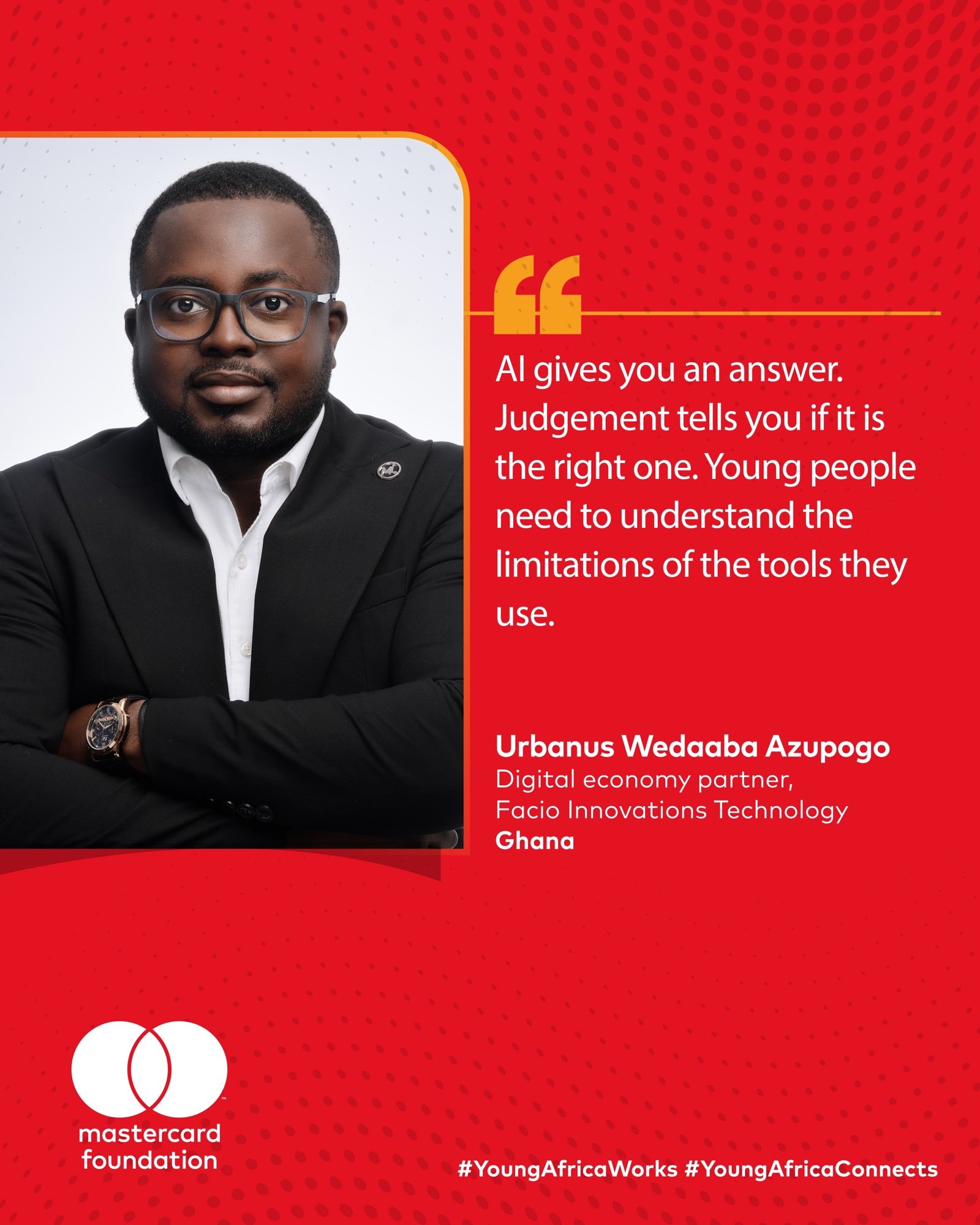
AI gives you an answer. Judgement tells you if it is the right one. Young people need to understand the limitations of the tools they use.
What frustrates me is that the demand is already sitting there. In our own market work, the overwhelming majority of the Ghanaian SMEs we looked at had no meaningful web presence. On one side a shop owner who wants to be online, on the other a trained young person with nothing to do that week, and no mechanism connecting them. Ghana is projected to need something in the order of nine million digitally skilled workers by 2030. That is not a forecast anyone needs to prepare for. It is a queue that has already formed.
I think mentorship is infrastructure, and I think we keep funding it as charity. That is the conviction behind what we are building at the Faciotech Foundation, and I would rather state it as a position than dress it up as a discovery. But I want to be careful with it, because "get a mentor" is also the kind of advice that sounds like a solution and functions like a shrug. One hour a month from a professional does not absorb 1.3 million people. It is not a policy. It is only the smallest unit of the thing that actually works, and I do not yet know how you scale a relationship without hollowing it out. Nobody on that panel knew either. We were all, in our different accents, describing the same missing middle.
If I could hand every young African entering the market in 2030 one thing, it would not be a language or a framework. It would be the habit of learning on purpose. Knowledge is abundant now and nearly free; converting it into competence, repeatedly, while the ground moves, is the scarce act. And the fastest way anyone has ever learned to do that is next to somebody slightly further along.
Talent is evenly distributed. Opportunity is not. I have spent the week since that panel turning over the uncomfortable half of that sentence, not the part about the young people, which is easy to say, but the part about the people like me who are already inside the door and decide, project by project, how far it opens.
Stay Informed
Periodic insights on research, entrepreneurship, and African scholarship. No spam, unsubscribe anytime.